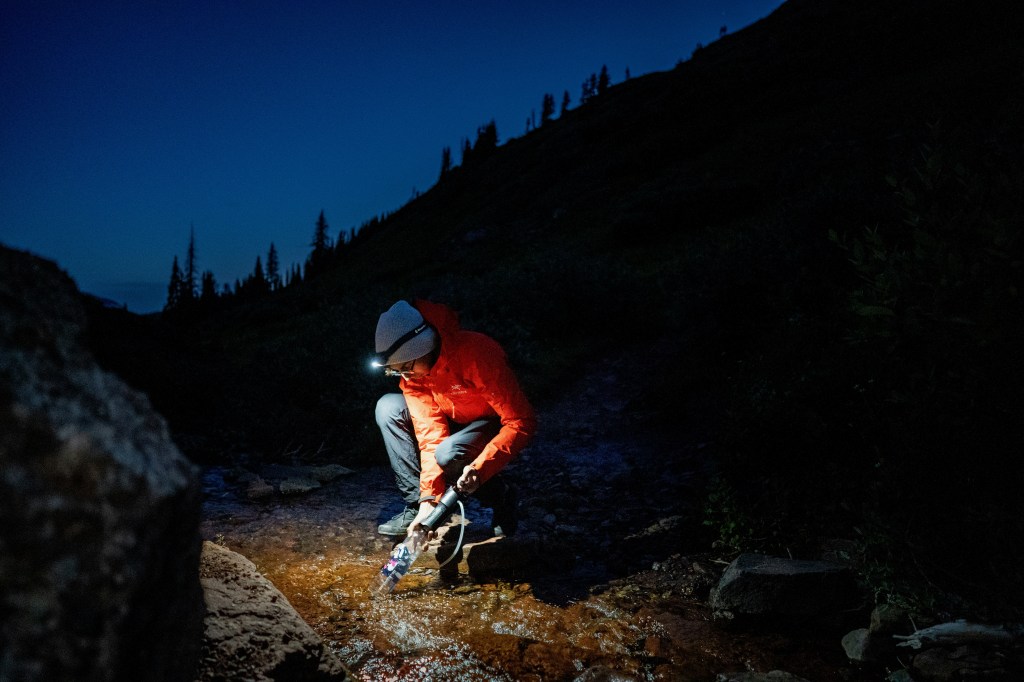
There’s a version of this conversation that happens in a gear store, where someone behind a counter tells you which water filter is best based on what’s selling that month. This isn’t that conversation.
I’ve filtered water in Burma, Iraq, and across enough backcountry terrain to know that the filter you choose matters — and that the wrong choice at the wrong time isn’t an inconvenience, it’s a medical evacuation. What follows is a straight best-to-budget breakdown of the options I’ve seen perform in the field, what they’re actually good for, and where they fall short.
No fluff. Let’s get into it.
1. GRAYL GeoPress — ~$99 | The Best All-Around Purifier
Best for: International travel, austere environments, anywhere viral contamination is a real threat.
If you’re operating outside the continental U.S. — and especially if you’re in regions with compromised water infrastructure — the GeoPress is the one to have. It’s the only filter on this list that kills viruses without chemicals. That matters more than most people realize until they’re sick in a place where getting sick is a serious problem.
Fill the outer cup from any freshwater source. Press. Drink. Eight seconds, 24 ounces, done. It removes bacteria, protozoa, viruses, heavy metals, PFAS, microplastics, and chemicals in a single press. No pumping, no squeezing, no waiting for a chemical to activate.
The tradeoffs are real: it’s heavier than the Sawyer, the cartridge has a finite life (~350 presses), and replacement cartridges cost money. If you’re running silty water regularly, expect the press resistance to increase over time. Pre-filtering through a bandana extends cartridge life considerably.
But if the mission requires virus coverage and you don’t want to stack chemicals on top of a filter — this is the tool.
2. Sawyer Squeeze — ~$35 | The Field Standard
Best for: Domestic backcountry, extended operations, anyone who wants a filter that lasts indefinitely.
Three ounces. Fits in your palm. Rated to 100,000 gallons with no replacement cartridge — ever. When flow slows down, you backflush it and it’s good again. The Sawyer Squeeze has become the field standard for serious hikers and aid workers alike, and for good reason: it’s simple, it’s light, and it just keeps working.
The 0.1 micron hollow fiber membrane removes 99.99999% of bacteria and 99.9999% of protozoa. It does not remove viruses. In most domestic backcountry environments that’s a non-issue — viral contamination of wilderness water sources is rare in the U.S. Outside the U.S., you need to factor that in and either upgrade to the GeoPress or add chemical treatment alongside the Squeeze.
The included squeeze pouches are the weak link — they can split under pressure if you get aggressive with them. Use a CNOC or Smartwater bottle as your vessel instead and this system becomes nearly bulletproof.
3. LifeStraw Personal — ~$15 | The Backup and the Give-Away
Best for: Emergency kits, vehicle bags, handing to someone who has nothing.
At $15, the LifeStraw earns its place in every kit — not as your primary, but as your backup and your insurance policy. It’s a straw filter. You put one end in the water and drink through it. That’s it. No moving parts, no setup, no maintenance.
It removes bacteria and protozoa. It does not remove viruses. It does not filter into a bottle — you drink directly from the source, which limits its utility in a lot of field scenarios. You can’t use it to fill a cooking pot or a hydration reservoir.
I’ve seen LifeStraws distributed to civilians and partner forces in Burma where the alternative was drinking directly from whatever was available. At that price point and that simplicity, it’s hard to argue against carrying one or several. Toss one in your vehicle. Toss one in your go-bag. Hand one to someone who needs it.
4. Chlorine Dioxide Tablets — ~$10–15 | The Chemical Option
Best for: Backup purification, weight-critical situations, stacking with a filter for full coverage.
Chlorine dioxide tablets are not a filter. They don’t touch particulates, sediment, heavy metals, or chemicals. What they do is kill biologicals — bacteria, protozoa, and viruses — across a wide pH range, which makes them more effective than straight iodine in a lot of water conditions.
The tradeoff is time. Depending on the water temperature and turbidity, you’re waiting 15 minutes to 4 hours for the tablets to do their work. In cold or murky water, that wait gets long. The taste is noticeable but not unbearable — better than iodine, which tastes like you’re drinking a swimming pool.
Tabs are what you carry when every ounce counts and you need a backup that weighs nothing. Stack them with a LifeStraw or Sawyer for full-spectrum coverage in environments where viral contamination is a concern.
5. Betadine (Povidone-Iodine) — ~$8 | The True Last Resort
Best for: Austere emergency use, when nothing else is available.
Most people don’t know you can use Betadine to purify water. Eight drops per liter of clear water, wait 15–30 minutes, drink. In murky water, double it and wait longer. It kills bacteria, protozoa, and viruses. It does not filter anything. Particulates, heavy metals, chemicals — all of it stays in the water.
Like chlorine dioxide, it’s a disinfectant, not a filter. The iodine taste is strong. Long-term use isn’t advisable for people with thyroid issues or iodine sensitivity. This is not your everyday solution — it’s what you reach for when everything else is gone and you need to make a decision about water right now.
I include it here because it belongs in the conversation. A small bottle of Betadine weighs almost nothing, costs almost nothing, and most people already have it in their medical kit. In a true emergency it gives you a viable option. That’s worth knowing.
The Honest Bottom Line
Here’s how I’d stack it depending on where you’re operating:
Domestic backcountry: Sawyer Squeeze as your primary, chlorine dioxide tabs as backup. Done.
International or austere environments: GRAYL GeoPress as your primary. Chlorine dioxide tabs or Betadine as emergency backup.
Go-bag / vehicle kit: LifeStraw plus a small container of tabs. Cheap, light, covers the basics.
True emergency, nothing else available: Betadine and time.
The GeoPress costs more because it does more. The LifeStraw costs $15 because it does less. Neither is wrong — they’re tools for different situations. Know what you’re carrying, know what it covers, and know its limits before you need it.
That’s it. Drink clean water.
Some links in this post are Amazon affiliate links. If you purchase through them I earn a small commission at no extra cost to you. I only recommend gear I’ve actually used or seen perform in the field.
 Field Gear that Works!
Leave a comment