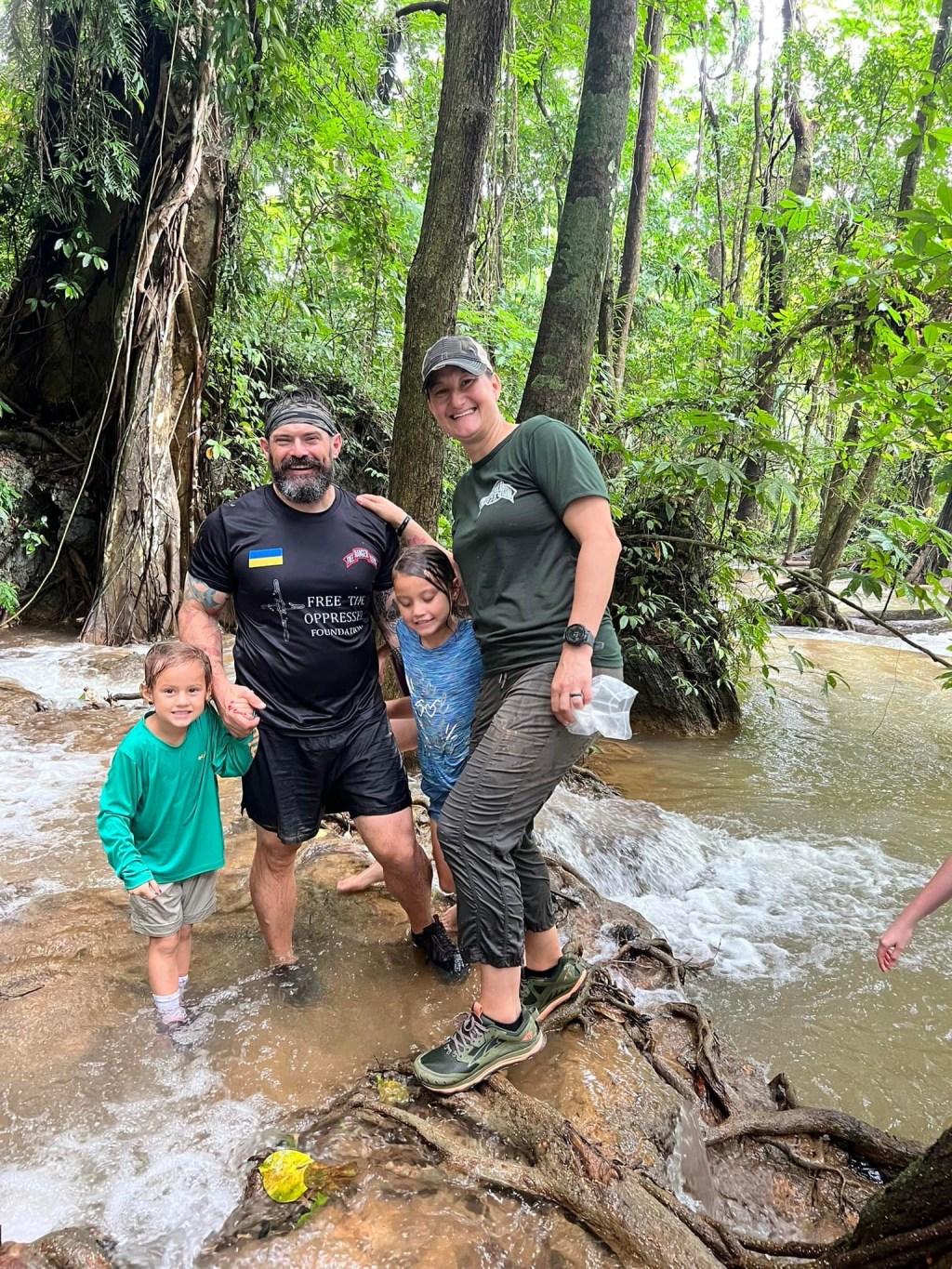
A counterintuitive lesson learned the hard way — from jungle operations with Free Burma Rangers
By Jeremy Cole | Retired First Sergeant, U.S. Army | Training Coordinator, Free Burma Rangers
Disclosure: This post contains affiliate links. I earn a small commission on qualifying purchases at no extra cost to you. Every product I recommend is something I personally use in active field operations.
The jungle is not what most people imagine. It is not just hot and humid. It is jagged rocks, prehistoric terrain, thorny undergrowth, river crossings at dawn, and an environment that will destroy cheap gear and punish bad decisions — including what you put on your feet.
And the most counterintuitive lesson I have learned in years of jungle operations with Free Burma Rangers is this: do not wear waterproof shoes.
“If your feet stay in waterproof shoes, your sweat mixes with water and creates a pool of nasty that your feet soak in. That causes a lot of heartache.”
I know what you’re thinking. You’re going into the jungle — rivers, rain, mud. Of course you want waterproof shoes. That thinking is wrong, and it will wreck your feet.
What Actually Happens to Your Feet in Waterproof Boots
In the jungle your feet are going to get wet. Period. There is no waterproof boot that prevents this entirely — not with river crossings, not with morning dew soaking through the undergrowth, not with the relentless humidity that saturates everything within hours.
Here is what waterproof boots actually do: they trap everything inside. Your sweat has nowhere to go. Any water that gets in has no way out. Within a day you have a warm, wet, enclosed environment around your foot — ideal conditions for skin breakdown.
After two or three days the skin turns white and soft. Cracks develop between the toes and along the heel. Every step becomes painful. In a temperate environment this is miserable. In the jungle it becomes a medical problem — because infection in a jungle environment is serious, difficult to treat, and can end an operation.
Trench foot is not a World War One problem. It happens in the jungle when people make the wrong footwear choice.
I have seen it. It is not pretty and it is entirely preventable.
Why Non-Waterproof Shoes Work Better
Non-waterproof trail shoes drain and breathe. When you cross a river your feet get wet — and they immediately start drying as you walk. The water moves through the mesh and out. Your body heat and movement do the work.
When you stop for the night you pull out the insoles, put on fresh socks, and the residual dampness inside is negligible. If you have a fire nearby you can set them close enough to the warmth to aid drying — not too close, but enough to make a difference. By morning they are ready to go.
Compare that to waterproof boots where the water that got in on day one is still sitting there on day three. There is no comparison.
Why I Chose Altra — And Why the Footbed Matters
I discovered Altra late in my Army career while serving with the 101st Airborne Division. I was training for trail runs and someone put me in a pair. The difference was immediate.
Altra builds their shoes with a wider, more natural footbed — what they call a FootShape toe box. For anyone with a normal to wider foot width this means your toes can spread naturally as you walk, the way your foot is actually designed to move. More surface contact with the ground means less load concentrated on specific pressure points, which means less fatigue and fewer injuries over distance.
Most boots are built on a narrow last designed for aesthetics, not function. After ten miles on rugged jungle terrain that narrowness costs you. The Altra footbed is built for the way feet actually work.
In jungle operations with Free Burma Rangers the two trail shoes I see most among experienced operators are Altra and Hoka. Both prioritize cushioning, natural foot movement, and drainage. Neither is a traditional jungle boot. Both outperform traditional jungle boots in sustained operations.
What About the Terrain?
The jungle is not just mud. It is jagged rocks, exposed roots, terrain that looks almost prehistoric — layered, complex, and unforgiving. You need a shoe with enough cushioning to absorb repeated impact across varied surfaces, enough grip to handle slick rocks and wet roots, and enough durability to survive thorny undergrowth that shreds cheap mesh within a day.
The Altra Olympus is my primary choice for maximum cushioning on the most rugged terrain. The Lone Peak is slightly lighter and my choice when the route is less extreme. Both have held up across multiple rotations in Southeast Asia.
What I do not recommend is the standard army jungle boot — heavy, stiff, and slow to dry even in the versions marketed as lightweight. The newer lightweight versions often sacrifice durability. You end up with something that is neither fast-drying nor long-lasting.
The Full Footwear System
The shoe is only half the equation. Socks matter just as much.
I run Darn Tough summer weight hiking socks on every rotation. They wick aggressively, resist blisters, and hold up to hard use. Darn Tough backs them with a lifetime guarantee — if they ever wear out they replace them free. In the jungle I carry three pairs minimum and rotate them daily.
Fresh socks in a damp shoe make the difference between a manageable situation and a foot problem. Never underestimate this.
The Bottom Line
If you are heading into serious jungle terrain — whether for humanitarian operations, adventure travel, or any sustained activity in a tropical environment — leave the waterproof boots at home.
Get non-waterproof trail shoes with a natural footbed, a quality cushioning system, and mesh that drains fast. Pair them with wool or synthetic hiking socks that wick and dry quickly. Check your feet daily, treat any hotspots immediately with betadine, and rotate your socks.
Your feet are your mission. Protect them correctly.
Recommended Footwear
Altra Olympus — Maximum cushioning, wide footbed, ideal for rugged jungle terrain:
→ Altra Olympus Trail Shoe — https://amzn.to/47dG4lR
Altra Lone Peak — Slightly lighter, excellent for moderate jungle terrain:
→ Altra Lone Peak Trail Shoe — https://amzn.to/3PoO2T1
Hoka Speedgoat — Strong alternative to Altra, excellent cushioning and grip:
→ Hoka Speedgoat Trail Shoe — https://amzn.to/4uJ3v0q
Darn Tough Hiking Socks — Lifetime guarantee, best socks I have used in the field:
→ Darn Tough Hiking Socks — https://amzn.to/4bXNsnS
Betadine Antiseptic — Clean every cut and hotspot immediately:
→ Betadine Antiseptic — https://amzn.to/4cWA2JZ
If you found this useful, check out the full jungle field kit list at provenfieldgear.com — everything I carry into operations with Free Burma Rangers, with honest notes on what works and what I wish I had brought.
And if you want to support the humanitarian work we do in Southeast Asia, visit colefamilymissions.org.
This post contains affiliate links. I earn a small commission on qualifying purchases at no extra cost to you. Every product listed is something I personally use in active field operations with Free Burma Rangers.
 Field Gear that Works!
Leave a comment